
Why Gym Lighting Upgrades Matter for Fitness Centers and Weight Rooms
Helpful content for facility managers and owners
Why Gym Lighting Upgrades Matter for Fitness Centers and Weight Rooms
Walk into a busy fitness center and it doesn’t take long to notice when the lighting isn’t quite right.
Maybe the cardio area is bright, but the free-weight section feels dim. Perhaps the mirrors reflect every overhead fixture, creating uncomfortable glare. Or the equipment is modern and the facility is spotless, yet the room still feels dated.
High school weight rooms can have similar problems. Equipment gets upgraded, training programs evolve, and spaces are rearranged to accommodate more students. Meanwhile, the lighting may be exactly where it was twenty years ago.
For the people responsible for maintaining these facilities, a gym lighting upgrade is an opportunity to improve the space while addressing some very practical operating expenses.
The advantages go beyond replacing aging fixtures with LEDs. They involve the experience of the people using the facility, the demands placed on maintenance teams, and the cost of keeping those lights running year after year.
Quick Answer
Upgrading lighting in commercial gyms and high school weight rooms can improve visibility around exercise equipment, reduce harsh glare and uneven lighting, lower electricity consumption, and reduce ongoing maintenance. Modern LED systems also provide opportunities for better scheduling and lighting controls. The greatest value comes from choosing fixtures and layouts that fit how the room is actually used.
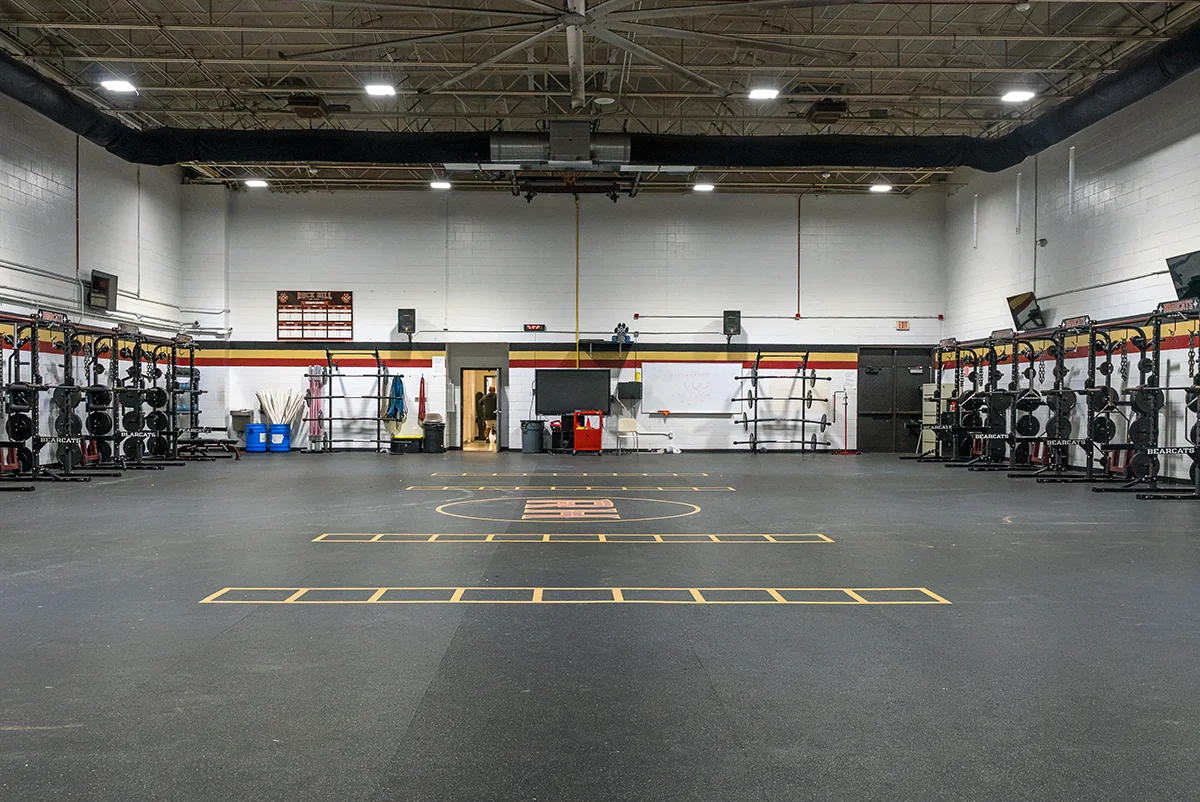
A Good Workout Environment Needs More Than Bright Lights
A weight room presents some unusual lighting challenges.
Think about the different ways people use the space. Someone using a treadmill is typically looking forward. A person doing squats may be watching their form in a mirror. Someone lying on a bench press is looking almost directly at the ceiling.
That last example is important. A fixture that seems perfectly acceptable when you’re standing in the doorway may create uncomfortable glare for someone exercising beneath it.
Then there are the racks, cable machines, partitions, and other equipment that can block or redirect light. Moving a large piece of equipment may even change the way an area is illuminated.
A well-designed lighting system accounts for these conditions.
The goal is consistent, comfortable visibility where people actually train. That includes the areas between equipment, not just the open sections of the floor.
When facility managers evaluate a lighting upgrade, it’s worth looking at the room from several perspectives instead of relying solely on the number of fixtures or their advertised brightness.
For Commercial Fitness Centers, Lighting Is Part of the Member Experience
Fitness centers compete on equipment, convenience, cleanliness, amenities, and the overall experience they provide.
Lighting plays a part in that experience, whether members consciously recognize it or not.
In a busy membership-based gym, the lighting helps establish how the space looks and feels from the moment someone enters. Brightness, consistency, color quality, and glare control can influence how welcoming or uncomfortable different areas feel.
A facility with uneven lighting may look older than it actually is. Dark areas can make equipment and floors harder to see, while overly intense fixtures can make mirrors unpleasant to use.
There is also the issue of visual consistency.
For operators managing multiple fitness centers, lighting decisions may need to support a recognizable brand environment across locations. That doesn’t necessarily mean installing identical fixtures everywhere. It means establishing a consistent experience while accounting for differences in layouts, ceiling heights, and equipment.
An upgraded lighting system will not guarantee new memberships or improve retention by itself. But it is a visible part of the facility experience, and one that may deserve more attention during a renovation or capital improvement plan.
High School Weight Rooms Have Their Own Priorities
A high school weight room is not the same environment as a commercial fitness center. It also isn’t necessarily the same as the school’s main gymnasium.
That distinction matters when choosing lighting.
Weight rooms may be used for physical education classes, team training sessions, strength and conditioning programs, and after-school athletics. Coaches and instructors need to see students and equipment clearly. Students need adequate visibility while moving between stations, selecting weights, and following instructions.
The room itself may have been adapted from another use. Ceiling heights, fixture locations, equipment placement, and available electrical infrastructure can vary considerably from one school to another.
School facility managers also have to consider durability, maintenance access, scheduling, and the long-term cost of the system.
A lighting upgrade should be evaluated around those needs rather than assuming that the specifications used for a basketball court or a general-purpose classroom will automatically work in a weight room.
Better visibility can support a more functional training environment, although lighting is only one part of a safe facility. Proper supervision, equipment condition, and training practices remain essential.
For school districts, a thoughtfully designed LED upgrade can be a practical improvement that benefits students, coaches, and the maintenance team for years to come.
Energy Savings Matter, Especially When the Lights Are On All Day
Commercial gyms can have demanding operating schedules.
Some open early in the morning, remain busy throughout the evening, and operate seven days a week. Even during quieter periods, much of the facility may remain illuminated.
That creates an opportunity for energy savings when older fluorescent, metal-halide, or other inefficient systems are replaced with appropriately selected LEDs.
High school weight rooms operate differently, but their lighting costs still add up over time. Regular school hours, athletic practices, weekend events, and seasonal programs all affect how frequently the lights are used.
The financial benefit of an upgrade depends on the existing system and how the building operates.
A realistic evaluation should account for current and proposed wattage, annual operating hours, electricity rates, installation costs, maintenance expenses, and available utility incentives.
For a commercial gym, extended operating hours may make energy reductions especially valuable. For a school district, those savings may be one part of a broader investment in modernizing its facilities.
Either way, the decision should be based on a meaningful comparison, not an assumed savings percentage.
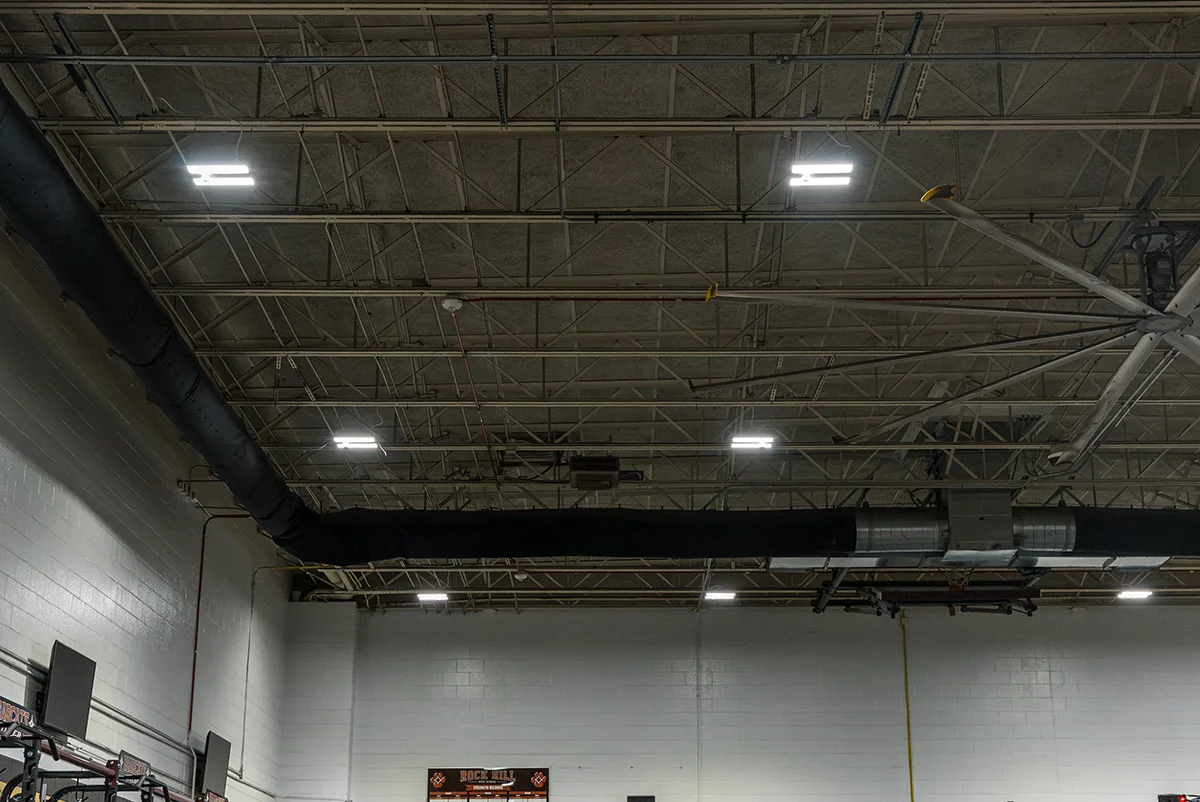
Reduced Maintenance Can Be Just as Valuable as Reduced Energy Use
Anyone responsible for maintaining a commercial facility knows that replacing a light isn’t always a simple task.
In a high-ceiling gym, changing a failed lamp or ballast may require specialized access equipment. Training areas might need to be closed temporarily, equipment moved, and staff assigned to coordinate the work.
That creates costs beyond the replacement part itself.
LED fixtures generally offer longer service lives and fewer routine lamp replacements than many older lighting systems. They are not maintenance-free, but a properly selected system can reduce the frequency of lighting-related service work.
For a commercial gym, fewer interruptions help keep equipment areas available to members.
For a high school, fewer maintenance visits can reduce the burden on a facilities department responsible for multiple buildings, athletic spaces, and competing repair priorities.
Those benefits belong in the financial discussion. A lower-maintenance system may deliver meaningful value even when the electricity savings alone do not tell the full story.
Lighting Controls Can Help, Provided They Match How the Gym Operates
Lighting controls offer additional opportunities to manage electricity consumption.
In a commercial fitness center, the main workout floor, group exercise rooms, offices, storage spaces, and other support areas may all have different operating schedules.
There is little reason to illuminate an empty group fitness studio at full output simply because the main gym remains open.
Similarly, a high school weight room may be occupied before classes, during the school day, and again for athletic training. Its schedule may also change throughout the year.
Controls can help facilities manage those differences through scheduling, zoning, dimming, and occupancy-responsive lighting where appropriate.
However, not every control strategy works equally well in every part of a gym.
Occupancy sensors, for example, need careful consideration in areas where people may remain relatively still during an exercise. Nobody wants the lights dimming unexpectedly in the middle of a workout because the system failed to detect activity.
The important questions involve how the space is used, who manages the controls, and what settings will keep occupied areas reliably illuminated.
The goal is straightforward: reduce unnecessary energy use without creating inconvenience or compromising the facility’s required lighting.
A Lighting Upgrade Shouldn’t Become a Scheduling Headache
Even an excellent lighting design can create problems if installation isn’t planned around an operating facility.
Commercial gyms may have members using the building from early morning until late at night. Schools have classes, athletics, staff schedules, and student access restrictions that need to be respected.
A lighting project might require lifts, temporary equipment relocation, electrical shutdowns, ceiling access, or protection of finished floors.
These details should be discussed before work begins.
Depending on the building, installation may be organized in phases, scheduled around less-busy operating periods, or completed during school breaks.
A contractor should also assess the existing electrical infrastructure, determine whether retrofit components or new fixtures make more sense, and identify any additional work that could affect the budget or schedule.
The facility should understand the potential interruptions before approving the project. That makes planning easier for the people who have to keep the gym or weight room available.
What Should Facility Managers Evaluate Before Approving an Upgrade?
A gym lighting proposal should address the actual conditions of the space, rather than simply provide a fixture count and replacement price.
Before moving forward, facility managers should understand:
- Existing lighting performance: Where are the dark areas, uneven light levels, glare problems, or failing fixtures?
- Equipment and room layout: Does the proposed system account for mirrors, strength equipment, circulation areas, and ceiling heights?
- Lighting quality: Will the fixtures provide appropriate distribution, color quality, and visual comfort for the space?
- Energy and maintenance costs: How do the existing and proposed systems compare over time?
- Controls: Which areas could benefit from scheduling, occupancy sensing, zoning, or dimming?
- Installation requirements: How will access, electrical work, safety, and temporary disruptions be handled?
- Long-term operation: Who will maintain the new system, manage the controls, and handle warranty or service issues?
The answers help determine whether the proposal is solving the facility’s problems or simply replacing old equipment with something newer.
Better Gym Lighting Is a Facility Investment
A gym lighting upgrade may not be as exciting as new strength equipment, a renovated locker room, or a fresh athletic facility design.
But the lighting affects how those improvements look and how the space functions every day.
For commercial fitness operators, it can support a more comfortable, visually consistent environment while lowering operating and maintenance demands.
For schools, it can improve the usability of weight rooms while helping facilities teams manage long-term expenses and maintenance responsibilities.
And for the people approving the investment, it creates an opportunity to address several facility needs through one coordinated project.
The important thing is understanding what the current system is doing, what needs to improve, and how the proposed upgrade will perform after installation.
Planning a Gym or Weight Room Lighting Upgrade in South Carolina?
Shine Construction works with schools, commercial properties, and other operating facilities throughout South Carolina on LED lighting and electrical upgrades.
Our experience includes lighting improvements for Charleston County School District facilities, along with projects that require careful coordination around active buildings, electrical conditions, and operating schedules.
Shine Construction also recently updated the weight room at Rock Hill High School, and project photos are available.
If your commercial fitness center or school weight room is due for a lighting upgrade, our team can help evaluate the existing conditions, review potential solutions, and develop a practical installation plan.
Planning a Lighting Upgrade?
We Provide Lighting Solutions for Our Customers
If you're planning a lighting upgrade for your facility, talk with our team first about LED lighting for sports stadiums, warehouse retrofits, self-storage facility upgrades, municipal buildings, or other specialized projects.